Showing posts with label food. Show all posts

Sunday, June 17, 2018

The Italian Riviera: the Cinque Terre, May 2018


The harbor of Vernazza
After Lucca, we went on to visit the 5 fishing villages of the "Cinque Terre" on the Italian Riviera. These little towns still have some fishermen based in town, but now most of the money comes from tourism. The 5 villages are isolated from each other geographically by cliffs and hills, but there are boat and train connections from village to village. They are technically part of Liguria (main city: Genoa).

At the top of the pic:
Belforte Tower in the Doria castle atop Vernazza
You can left-click on each picture to see it in a larger version.


We had great food (pesto and fresh fish) and wine and did short day trips to the other villages. Our apartment was on the main square on the harbor in Vernazza. We could hear the waves of the Mediterranean lapping at the shore. Anchovies are available fresh from the Mediterranean and they are prepared in so many ways to provide a very different experience than anything we were familiar with in the US!

A view of the Vernazza harbor. Our apartment was in the house
that is one window wide to the left of the light pink house

Anchovies done right - the local anchovy "pie"


The weather was sunny but not too hot, because there was always a breeze from the Mediterranean.


Each town of a few hundred natives is separated from the rest by high hills and cliffs. During the afternoon, Richard took hikes in the hills above the towns where there are little isolated chapels called sanctuaries.
Reggio Sanctuary from the trail

The one above Vernazza is called the Reggio Sanctuary. It is know for a portrait of the Virgin Mary  called the Black Madonna, presumably because her garment appears to be black. The church was built in the eleventh century on the ruins of an ancient religious structure. The current building is plain on the outside, but inside it is beautifully decorated. The area around the church is peaceful, and the trees offer plenty of shade after a challenging hike up the hill.


Inside Reggio Santuary


A side street in Vernazza

Coastal hillside with terraced vineyards


view from Winexperience

Kathy usually stayed around our little apartment that had a view of the harbor and piazza in Vernazza or wandered up and down the only street of the town shopping for groceries or good restaurants. One evening, we went to a balcony overlooking the sea, where a wine-tasting establishment called Winexperience serves some incredible Italian wines (and only Italian wines). The most unusual red wine smelled wonderfully like leather (and Richard detected a hint of saw dust). It tasted great, but he didn't want to drink it all because it smelled so good.
After several whites and reds, we finished with a desert wine called Sciacchetrà, which is made from grapes that are only grown in the Cinque Terre. It was so good that we later found a bottle in town to buy as a souvenir. It is sometimes served with little biscottis called bucellato.
The sommelier, Alessandro, spent time with us explaining each wine, and his enthusiasm was infectious.


On other afternoons, we took the train or the boat to the other little towns, which were all just as crowded, but each one had their own charm with either more of a beach-and-hotel scene (Monterosso), or a much smaller harbor so that the fishing boats were sitting on part of the town square about 20 feet above the water, having been hauled up there by a crane, as in Manarola!

vineyards surrounding Corniglia
Richard went to another sanctuary one afternoon, this one called Santuario della Madonna delle Grazie (the sanctuary of our lady of graces), and located above Corniglia. The view of town from the path up to the church was beautiful. Corniglia is the only one of the five villages without a harbor. In fact, the town sits on above the cliffs with no river valley leading down to the sea. But the town is a colorful patch in a landscape of vineyards. And the town itself is very charming. It is the smallest of the five villages, and the streets and sidewalks are correspondingly narrow.
In Corniglia
Corniglia from a distance

Monterosso from the sea.
We took a boat  to Monterosso, where the harbor is in the new town. This part of town gives Monterosso a slicker atmosphere. This is the largest of the five villages, and it is where you will find hotels, for example, something hard to come by elsewhere in Cinque Terre.  Here is where we found the Oratorio della Confraternita dei Neri Mortis et Orationis, which is roughly translated as the Oratorio (chapel) of the Brotherhood of the Black Death and Prayer. It's not really a church, but rather a chapel and meeting place for an organization that cared for the families of the fishermen who died at sea. Skeletons were everywhere to be seen.
It was also interesting to watch the workers performing the careful restoration of the frescoes as they applied a fine layer of what looked like cheesecloth and plaster to the walls.

Oratorio della Confraternita
dei Neri Mortis et Orationis
Examples of many skeletons in the Oratorio


Old town of Monterosso
 The old part of town is where you find the rustic charm of the Cinque Terre


Riomaggiore has the most rustic harbor of the villages. It seemed to us to be more a pile of rocks than a harbor, and there is no beach. But it fits in wonderfully with the shear cliffs surrounding it.

There is a footpath from the harbor of Riomaggiore through a tunnel to the train station and then farther to Manarola. The path between towns is called the Via d'Amore (Lover's Lane) due to the beautiful views.


 Manarola seems to have a little more room than the other villages. Near the harbor there is a small town square (Piazza Capellini) with a mosaic of the local fish and birds. Higher up in the town in front of the Chiesa di San Lorenzo (Church of Saint Lawerence) is another small square with the bell tower overlooking town.


During the summer season, the villages are populated by a few hundred natives, who in the course of the last couple decades have shared their towns with thousands of tourists daily(!) in a continual stream from May to October. It's like Lake George on July 4th all season long! We don't know how they put up with the constant crowds. We saw some of them on the harbor-front square in front of our apartment in the early daylight hours having coffee and chatting outside the small bar across the plaza. We were glad to have an apartment to retreat to during the most crowded hours when we weren't visiting the other towns ourselves or retreating to the hills.


Sunday, June 10, 2018

Lucca, Italy, for fun and profit

Richard attended a technical conference in Lucca, Italy, for work from May 13th through the 19th this year 2018. He gave a presentation and published a paper.
Richard giving his presentation


Conference participants in the courtyard


The conference was held at the Real Collegio, a renovated cloister attached to the S. Frediano church. (see bell tower outside of courtyard in the photo.) The old monastery was extensively modified during the 17th century with the addition of two main cloisters. In 1779 the Republic of Lucca decided to use the building as a “university institute”, and Pope Pius VI disposed the S. Frediano community patrimony for the construction of the new institute. In the 19th century, the institute received the name of “Real Collegio Carlo Lodovico” from Charles Louis of Bourbon-Parma, Duke of Lucca, and it remained an educational institution until 1939.

During the evening on Monday of the conference, a performance was given by sbandieratore or bandieraio. These modern-day flag throwers have their origins in the military flag-bearers of past centuries who led troops into battle.  The flag throwers had to transfer orders from the leaders to the troops.  It was imperative that they not let their flag fall into enemy hands, because this could lead to confusion and defeat. In order to save the flag, they perfected the long, high throw.
I suspected that there was a military connection already as soon as I heard the accompanying drummers. Just the two large drums alone were terribly loud, and when the dozen or so drums were added, it was as deafening as the loudest rock concert. I was reminded immediately of bag pipes, which also have a military connection.
On Wednesday of the conference participants were treated to supper at the Palazzo Pfanner.
Palazzo Pfanner
Statues and fountain in the garden
Main hall of the Palazzo
 The Palazzo as it now with its monumental main stair case was constructed by the Controni family, who bought the Palazzo in 1680.We started with champagne and appetizers in the baroque garden, and then moved to the main hall for dinner, where there are beautiful frescoes painted around the year 1720. In 1845, the Duke of Lucca, Carlo Lodovico di Borbone hired for himself and for the townspeople “a German brewer”. In 1846, Felix Pfanner, a Bavarian brewer, rented the garden and the cellars of the Palazzo from the Controni family in order to become the first beer manufacturer of the Duchy of Lucca and one of the first in Italy. Eventually, Pfanner was able to buy the whole Palazzo from the proceeds, and the Palazzo became the official headquarters of the Pfanner Brewery. The brewery  closed in 1929, but the Palazzo is still the property of the Pfanner family, who lives here.


facade of San Frediano


After walking by the basilica of San Frediano every day on the way to and from the conference, it was time on Friday to take a look inside. The church is famous for the large mosaic on its facade. The church as it is today was consecrated in 1147. A city could only have one baptismal church in the middle ages, but because San Frediano was outside the Roman wall at the time and the cathedral was inside, San Frediano became the second baptismal church of Lucca around the year 1000.
baptismal font in San Frediano
This first thing you notice is a Romanesque baptismal font. It is from around the 12th century, and it depicts the Israelites as knights in armor crossing the Red Sea on horseback. Nope, I don't understand either. Stories of Moses are on the large lower basin, and the small round temple on the lid has the apostles and months of the year.
In a chapel on the left is a fresco of the arrival of the Santo Volto (the Holy Face) in the basilica. The fresco cycle commemorates the legend of Nicodemus' sculpting the figure of Jesus in Lebanon cedar. When he completed all but the face, Nicodemus fell asleep, and woke to find the Holy Face completed by an angel. The wooden sculpture was transported to the basilica in the year 742 from Luni, which was a Byzantine possession that had been sacked by Saracens.
freco of the transport of the Santo Volto
In another chapel is an altar with a Roman sarcophagus containing the body of Saint Richard the Pilgrim, an English “king” (of Wessex). Before you ask, "who cares?", there's a spoiler: he is connected to a saint who is famous in our region of Franken. He died in Lucca in 722 while on pilgrimage to Rome. Miracles were reported to have occurred at his tomb, and a cult venerating him developed. His wife, Winna, was the sister of Saint Boniface, who was the  Archbishop of Mainz and is the patron saint of Germany.
sarcophagus of Richard the Pilgrim


Richard and Winna were the parents of Willibald, Bishop of Eichstätt; Saint Winibald, Abbot of Heidenheim; and Walpurga, Abbess of Heidenheim, which are towns not far from here in Franken. Saint Walpurga became a nun in the double monastery of Heidenheim am Hahnenkamm, which was founded by her other brother, Willibald, who appointed her as his successor. Following his death in 751, she became the abbess. When she died, she was buried at Heidenheim; but in the 870s, Walpurga's remains were transferred to Eichstaett. Her feast day commemorates the transfer of her relics on 1 May. At some point she came to represent the older pagan concept of the Grain Mother. Peasant farmers fashioned her replica in a corn dolly at harvest time and told tales to explain Saint Walpurga's presence in the grain sheaf. Her earliest representation is in the early 11th-century Hitda Codex, made in Cologne, which depicts her holding stylized stalks of grain. The night before her feast day became the Walpurgis Night mentioned in Goethe's novel "Faust" and in Thomas Mann's "The Magic Mountain" and in Edward Albee's play "Who's Afraid of Virginia Woolf?". It is celebrated in continental folklore with dancing and bonfires to ward off witches and evil spirits.
Our own area has a Walpurgisnacht celebration on a local hill that is nicknamed after Walpurga. The Ehrenbuerg, a table-topped formation east of Forchheim, just north of Erlangen, is always referred to as the Walberla. A small chapel on the hill top is dedicated to Walpurga. On April 30th, people go up on the Walberla, some dressed as devils or witches, and drink and make bonfires, which they dance around until well after midnight on May 1: Walpurgisnacht. The local legend relates that St. Walpurga converted the local witches to Christianity and in return for their conversion, she promised them that one night per year, they could celebrate as in the pre-Christian days. It's probably not a coincidence that May 1st is an ancient pagan festival in the Celtic countries called Beltane.

The cathedral in Lucca has the Santo Volto, which is an early 13th-century copy stored in its own temple. Perhaps the original was chipped away beyond repair by relic-seeking pilgrims.
Temple with Santo Volto
View of Santo Volto through the screen door
The temple was closed when we were there, but the screen in the door allows a view of the Santo Volto.

Ceiling in the apse of the cathedral
 The rest of the cathedral is very beautiful. The apse has a beautiful fresco. And the floor has a marble inlay depicted the Judgement of Solomon. (The baby is difficult to see, but look closely between Solomon on the throne and the soldier to the left of Solomon.)
Marble inlay showing Judgement of Solomon


The old city center of Lucca has a complete 17th century wall around it, and what remains of the Roman amphitheater is now a circle of houses with restaurants and shops in the ground floor. We stayed in a small B and B near the "Anfiteatro" with a couple of Richard's colleagues whose wives also visited them. The B and B was nicely decorated with murals from the Age of Chivalry.
Room at Corte dei Nobili


The Anfiteatro was, of course built in the ruins of a Roman amphitheater. In the middle ages, houses and restaurants were built inside up against the ancient walls and the floor of the arena was retained as the central plaza. We regularly ate breakfast and dinner at restaurants inside the old walls.

We had fun going out to dinner together and getting tips on what to look for when exploring. One great tip was a great book store with a stained glass ceiling and pillars inside that also included a café. Of course there were dozens of old Romanesque churches and plazas. While we were there, there was an antique car meet and parade involving lots of people wearing matching costumes riding around in their open-topped early-20th-century roadsters, having fun.


Sunday, July 19, 2015

Children's parade in Dinkelsbühl, or when the children saved the day

July 2015
Kinderzeche is a strange name for an annual reenactment in Dinkelsbühl of a day in the 30-Years' War. (the worst war in German history that took place from 1618 until 1648) According to legend, the Swedes had surrounded the city, and threatened to break down the fortress walls surrounding the town. That would lead to the usual atrocities including raping and pillaging. The city fathers didn't know what to do, their defenses being exhausted. Unknown to them, a young woman named Lore took matters in her own hands. She gathered all the children in the town around her, and she walked out of the city walls into the hands of the enemy, where she begged for mercy for the children.  The Swedish commander took pity, and agreed not to destroy the town if the city fathers surrendered, which they did.

Today, the children of town still play the dominant role in the 11-day celebration. They are celebrated as the heroes of the town, and they parade from the city hall, out to the Swedish encampment just outside the city walls, then back in with the soldiers to meet today's city council. Every aspect of the parade has to do with some detailed aspect of the city's history. Nothing is without meaning.

The parade starts with the children, who are led by Lore out to the Swedish encampment. The legend has it that Lore heard of the recent death of the Swedish colonel's young son, so the boy she leads by the hand was chosen because he resembled the colonel's son. Apparently, this had the desired effect on the colonel.


The children meet the Swedish soldiers, who have been waiting outside in their encampment.

... which is just outside the city walls.
By the way, they have been eating very well, and tourists get to sample the roast suckling pig as well. While we felt sorry for the piglet, it was very tasty!

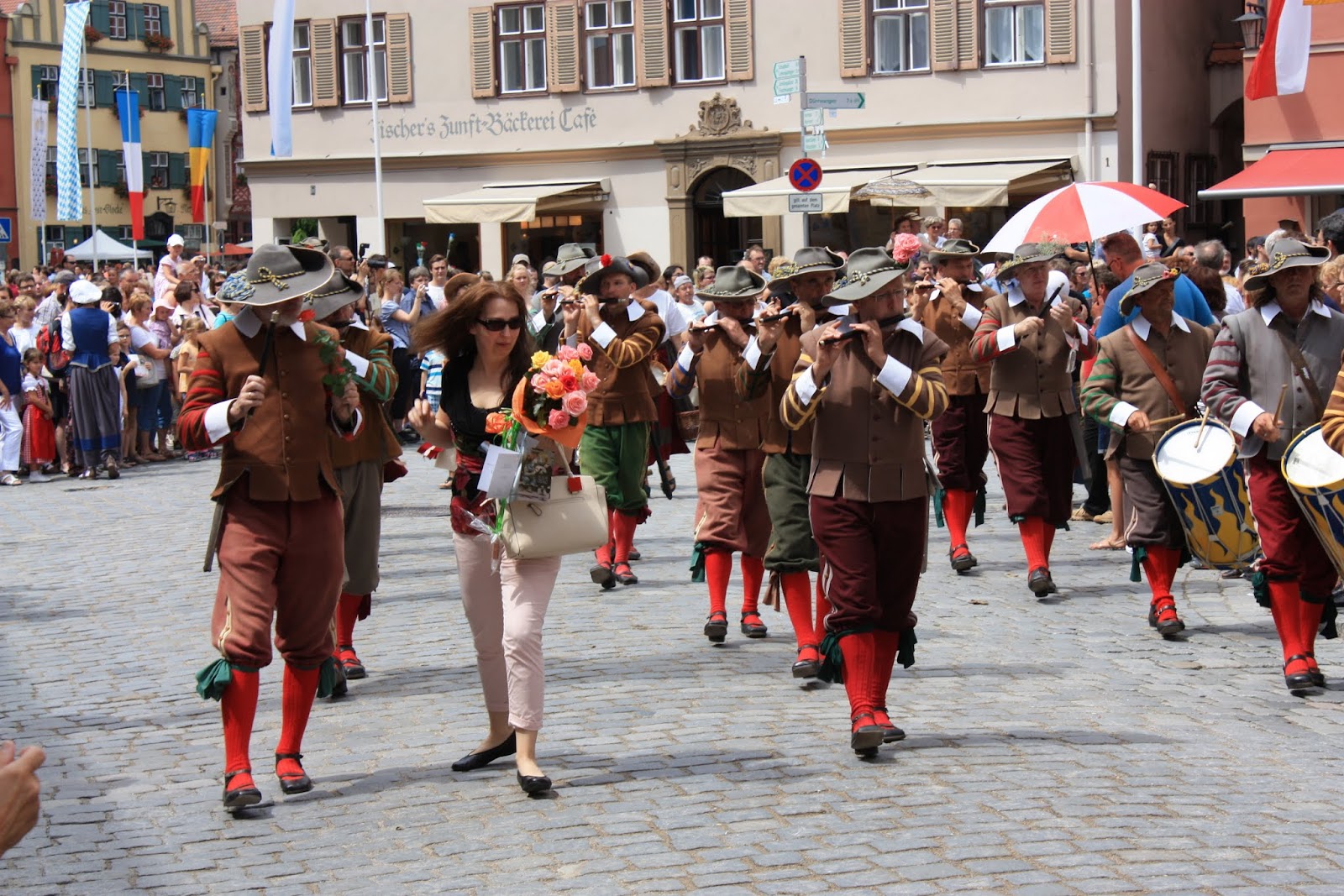
The children and the soldiers march into the city, where they are greeted by the young ladies of the town, who offer them flowers as a symbol of peace.
Then everyone parades through town, starting with the victorious Swedes,

... including the wounded,
... then the children,
...then the Knabenkapelle (boys' marching band),

... then the Schäferreigens, representing the importance of the wool trade to the city's economy (schaf means sheep); they wear the simple everyday clothes of the sheep farmers, wool handlers and weavers


... then the Tracht (traditional costume) club from Segringen, wearing the traditional costumes of a farming village; these clothes are the Sunday best,

... then the Biedermeier club in their white dresses with hoop skirts; in Germany, the Biedermeier period was between 1815 and 1848 during which the middle-class grew and arts appealed to common people. It was a bit like the 1950s in America. It ended with the failed revolution in the 1840s when people turned away from political involvement and concentrated on their own lives; (I can hear Julie Andrews singing "... girls in white dresses with blue satin sashes,"

... then another group representing the colorful, cone-shaped goody bag that all the participants in the parade receive; the four girls in front are carrying a giant version of the goody bag, called a "Gucke" (it's a traditional name - if you look it up, you won't find the goody bag definition)


... then the smiths' and weavers' guilds' dancing clubs in their tracht; the smiths' guild performs a sword dance and the weavers' guild has their own unique dance. The two guilds competed for precedence in the 17th century.


Lastly, the mayors (all 3 of them; they each ruled for 4 months of the year) and the city council.  


During the parade, the bystanders run out to give the children little bags of candy, and the men get little bottles of alcoholic spirits or flowers.


The parade ends in front of one of the oldest buildings in town, where the viewing stands have been erected. The flag of the city is given to the Swedish forces. The marching band then plays a song written in the 1800s for this occasion. Everyone who knows it sings along. It was also printed in the program we had, so we tried to sing along as well. The opening lines are, "Let songs of joy resound from south, north, east and west" and it goes on to praise innocence, the jewel of youth. It is a song of joy and friendship and ends asking for God's blessing on the country.


It was a wonderful "feel good" day. Maybe because of the emphasis on the kids, maybe because of the flowers being passed around, maybe because of the good food and beer, maybe because of the nice weather and beautiful costumes, maybe because of the setting (I forgot how colorful the buildings in Dinkelsbühl are.)