Showing posts with label textiles. Show all posts

Monday, April 10, 2023

Der Georgiritt, riding with St. George

 An annual blessing of the horses takes place every Easter Monday in a little town to the east of Erlangen. This year we had great weather, so the onlookers were numerous, and we were too late for Knieküchla, literally "little knee cakes," named because they look like the dough was stretched over the baker's knee before being fried and dredged in sugar. But we saw the parade of horses.  It starts out with a procession out of the church led by the local priest and the altar boys carrying a statue of St. George, who is the patron saint of horses and riders.

wooden statue of St. George

Then the local priest blesses the horses, and a parade begins.

It's led by the mayor 

the mayor

and then the local priest

the local priest
Next are the drums. The rest of the band must wait back a distance behind the horses. Horses are easily spooked.

drums don't spook the horses?


A wagon carrying people in traditional costumes (Tracht, pronounced "traht") comes next. Notice the young unmarried women with the crowns. The woman who graciously let us take her picture with Richard wore Tracht that she inherited from her grandmother. Most of her clothing was 100 years old.


people in tracht
 

maidens' crowns
 

100-year old Tracht
Next come the beautiful horses. 


Even the humble come to be blessed. 

a humble donkey


The parade ends up back at the church. The church was built at the end of the 1400s as a Wehrkirche, which means a fortified church.

the Wehrkirche in Effeltrich
 

 The entrance to the fortress has statues of St. Lawrence and others above the gate.

entrance gate on left-hand side of fortress wall


The area between the fortress and the church is a graveyard.


inside the fortress wall

view of church entrance from entrance gate

 Inside the church are the baroque decorations.

inside the church


Across the street from the church is the "Thousand-Year Linde", a linden tree that is probably about 800 years old.


1000-year Linde

The village used to hold dances in its branches.

See our previous blogs at 2007 (skip down to the heading "Easter Monday Excursion")  and   2015  (Osterbrunnen: decorated town fountains with evergreen and colored eggs before Easter)


Monday, April 22, 2019

Easter in Munich (2019): Bavarian national splendor

We spent a beautiful day in Munich on Easter Sunday. We spent much of it in the parks of Munich. We had lunch in the Englischer Garten and walked through the east side of the Isar river in the afternoon.
We decided to do something new, and since we had never been in the Bavarian National Museum, we checked it out. You read that right. Bavaria was once an independent nation with its own royal family!

The museum is built around the collection of the Wittelsbacher family, the pre-eminent noble family in Bavaria. This family was given the kingship of Bavaria when Napoleon rearranged Germany. They were kings up until the last one abdicated during the First World War. One of them, loopy Louis (Ludwig II) built the famous Neuschwanstein castle.

Many of the beautiful things in the museum reflect how the nobles lived in the good old days, when decadence was good. We saw a room full of ivory carvings. It turns out that ivory turning was an acceptable past-time for the members of the Bavarian royal family.


Other exhibits covered the exquisite clothes, jewelry and tableware of the days when one dressed and dined to impress. 
The fine embroidery on the white silk dress kept Kathy staring. The necklace consisted of garnets and silver, and the painted stones depicted characters from a masked ball. The silver structure below, a table centerpiece, featured small musician figures in the center surrounded by curtains made of silver lacework. The whole thing was a platform that held the salt and pepper shakers and other seasonings. Can't imagine polishing the thing!


This beautiful museum emphasizes the decorative arts. The museum has several rooms of sculptures by Tilman Riemenschneider, an artist whose work graces many churches in our region of Franconia. Some were very familiar, and some were bizarre. An example of the latter is the Ascension of Mary Magdalene showing Mary covered only by her own hair. (Click on the pictures to see a larger version)


The more familiar ones include the 12 Apostles. Most figures have an attribute for the method of martyrdom for each of the them.  It seems to me that Judas Iscariot has been replaced by Paul the Apostle.


Matthew was originally holding a quill (not seen) used for writing the Gospel.

Four soldiers took Thomas to a nearby hill and speared him.

Andrew was crucified on an X, which is also where the design of the Scottish flag comes from.


This one is the easiest. Peter has the keys to heaven, of course.

This is the tricky one. Paul (not one of the 12 Apostles) is holding a scroll (symbolising the Scriptures).

Simon the Zealot was sawn in half.


Philip was crucified upside-down, in deference to Jesus.

Bartholomew is shown with the knife because he was skinned alive.

James, son of Zebedee, wears a pilgrim's hat, because he is thought to be buried at Santiago, the great pilgrimage site. He was the brother of John, the Beloved.


John, the Beloved, was challenged to drink a cup of poison to demonstrate the power of his faith.

Jude, or Judas Thaddaeus, should be holding a spear, but it looks more like a club to me, which is sometimes his attribute also.

James, the Younger and brother of Jesus according to one interpretation of the Gospel of Matthew, has a slim club with a wooden board attached at a right angle to one end used by fullers to clean wool.

There were also several green men and a couple of wild men.


These wild men and green men are commonly found in Romanesque churches, the first churches built in stone. The stone churches usually replaced wooden churches that were built by the early missionaries on the same site. The depiction of these pagan figures, which are unique to these early churches, is intriguing. We wonder what these figures imply about the way Christianity was practiced between 800 and 1000 C.E., shortly after Christianity was adopted or forced on the Germanic tribes. What remained of the early pagan beliefs? It seems that the pre-Christian belief systems persisted, because the representation of nature spirits is tacked on to the Christian imagery. The undercurrent of pagan respect for nature is something we notice repeatedly here in Germany, where trees are protected by requiring applications to be filed before they are felled in the season that makes the least impact on the birds that nest in them. Other evidence of this pre-Christian respect for nature is that the fountains in the rocky, water-poor regions to our northeast are cleaned and decorated each year around Easter time with evergreen boughs and painted eggshells.


Sunday, July 19, 2015

Children's parade in Dinkelsbühl, or when the children saved the day

July 2015
Kinderzeche is a strange name for an annual reenactment in Dinkelsbühl of a day in the 30-Years' War. (the worst war in German history that took place from 1618 until 1648) According to legend, the Swedes had surrounded the city, and threatened to break down the fortress walls surrounding the town. That would lead to the usual atrocities including raping and pillaging. The city fathers didn't know what to do, their defenses being exhausted. Unknown to them, a young woman named Lore took matters in her own hands. She gathered all the children in the town around her, and she walked out of the city walls into the hands of the enemy, where she begged for mercy for the children.  The Swedish commander took pity, and agreed not to destroy the town if the city fathers surrendered, which they did.

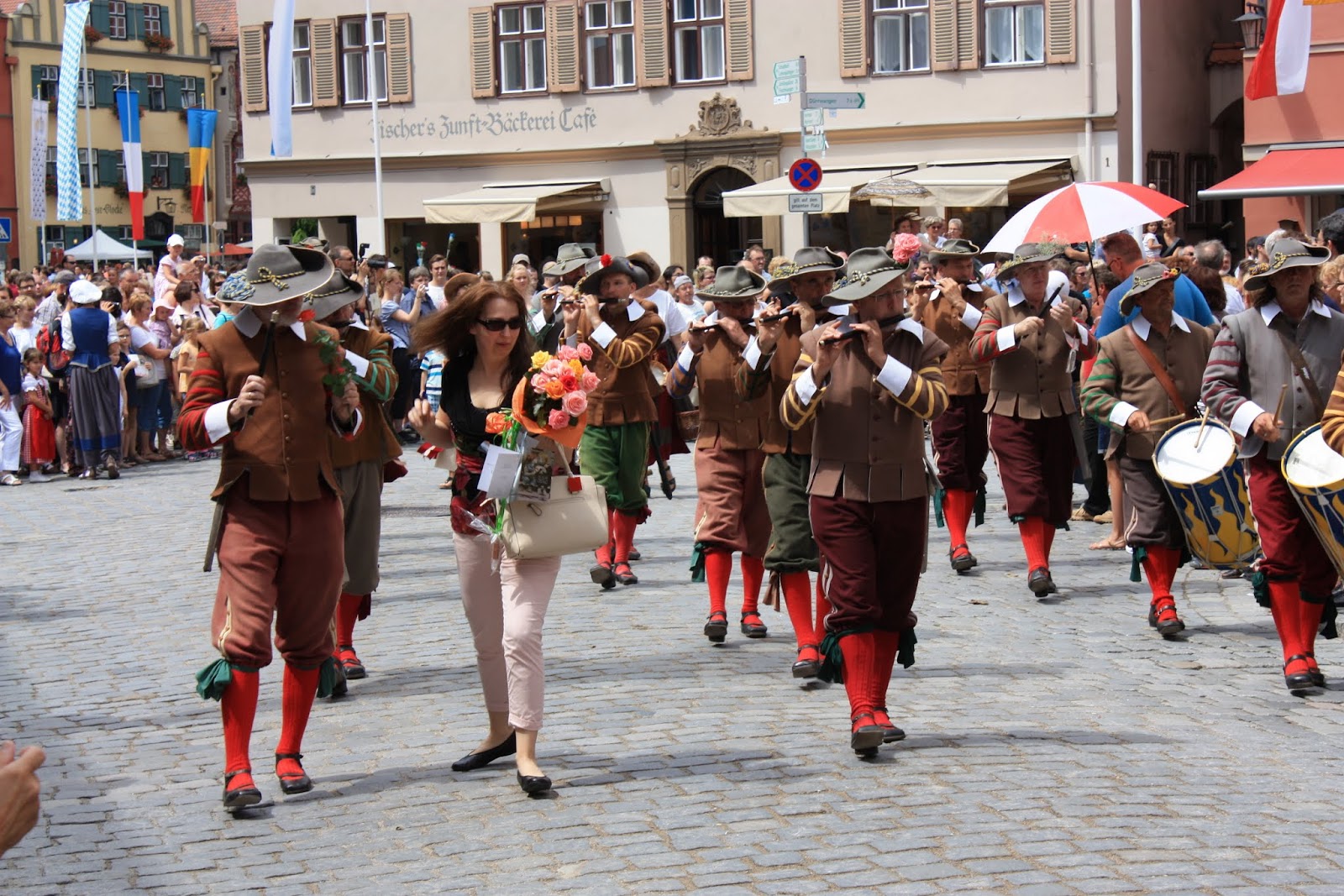
Today, the children of town still play the dominant role in the 11-day celebration. They are celebrated as the heroes of the town, and they parade from the city hall, out to the Swedish encampment just outside the city walls, then back in with the soldiers to meet today's city council. Every aspect of the parade has to do with some detailed aspect of the city's history. Nothing is without meaning.

The parade starts with the children, who are led by Lore out to the Swedish encampment. The legend has it that Lore heard of the recent death of the Swedish colonel's young son, so the boy she leads by the hand was chosen because he resembled the colonel's son. Apparently, this had the desired effect on the colonel.


The children meet the Swedish soldiers, who have been waiting outside in their encampment.

... which is just outside the city walls.
By the way, they have been eating very well, and tourists get to sample the roast suckling pig as well. While we felt sorry for the piglet, it was very tasty!

The children and the soldiers march into the city, where they are greeted by the young ladies of the town, who offer them flowers as a symbol of peace.
Then everyone parades through town, starting with the victorious Swedes,

... including the wounded,
... then the children,
...then the Knabenkapelle (boys' marching band),

... then the Schäferreigens, representing the importance of the wool trade to the city's economy (schaf means sheep); they wear the simple everyday clothes of the sheep farmers, wool handlers and weavers


... then the Tracht (traditional costume) club from Segringen, wearing the traditional costumes of a farming village; these clothes are the Sunday best,

... then the Biedermeier club in their white dresses with hoop skirts; in Germany, the Biedermeier period was between 1815 and 1848 during which the middle-class grew and arts appealed to common people. It was a bit like the 1950s in America. It ended with the failed revolution in the 1840s when people turned away from political involvement and concentrated on their own lives; (I can hear Julie Andrews singing "... girls in white dresses with blue satin sashes,"

... then another group representing the colorful, cone-shaped goody bag that all the participants in the parade receive; the four girls in front are carrying a giant version of the goody bag, called a "Gucke" (it's a traditional name - if you look it up, you won't find the goody bag definition)


... then the smiths' and weavers' guilds' dancing clubs in their tracht; the smiths' guild performs a sword dance and the weavers' guild has their own unique dance. The two guilds competed for precedence in the 17th century.


Lastly, the mayors (all 3 of them; they each ruled for 4 months of the year) and the city council.  


During the parade, the bystanders run out to give the children little bags of candy, and the men get little bottles of alcoholic spirits or flowers.


The parade ends in front of one of the oldest buildings in town, where the viewing stands have been erected. The flag of the city is given to the Swedish forces. The marching band then plays a song written in the 1800s for this occasion. Everyone who knows it sings along. It was also printed in the program we had, so we tried to sing along as well. The opening lines are, "Let songs of joy resound from south, north, east and west" and it goes on to praise innocence, the jewel of youth. It is a song of joy and friendship and ends asking for God's blessing on the country.


It was a wonderful "feel good" day. Maybe because of the emphasis on the kids, maybe because of the flowers being passed around, maybe because of the good food and beer, maybe because of the nice weather and beautiful costumes, maybe because of the setting (I forgot how colorful the buildings in Dinkelsbühl are.)