Showing posts with label customs. Show all posts

Monday, April 10, 2023

Der Georgiritt, riding with St. George

 An annual blessing of the horses takes place every Easter Monday in a little town to the east of Erlangen. This year we had great weather, so the onlookers were numerous, and we were too late for Knieküchla, literally "little knee cakes," named because they look like the dough was stretched over the baker's knee before being fried and dredged in sugar. But we saw the parade of horses.  It starts out with a procession out of the church led by the local priest and the altar boys carrying a statue of St. George, who is the patron saint of horses and riders.

wooden statue of St. George

Then the local priest blesses the horses, and a parade begins.

It's led by the mayor 

the mayor

and then the local priest

the local priest
Next are the drums. The rest of the band must wait back a distance behind the horses. Horses are easily spooked.

drums don't spook the horses?


A wagon carrying people in traditional costumes (Tracht, pronounced "traht") comes next. Notice the young unmarried women with the crowns. The woman who graciously let us take her picture with Richard wore Tracht that she inherited from her grandmother. Most of her clothing was 100 years old.


people in tracht
 

maidens' crowns
 

100-year old Tracht
Next come the beautiful horses. 


Even the humble come to be blessed. 

a humble donkey


The parade ends up back at the church. The church was built at the end of the 1400s as a Wehrkirche, which means a fortified church.

the Wehrkirche in Effeltrich
 

 The entrance to the fortress has statues of St. Lawrence and others above the gate.

entrance gate on left-hand side of fortress wall


The area between the fortress and the church is a graveyard.


inside the fortress wall

view of church entrance from entrance gate

 Inside the church are the baroque decorations.

inside the church


Across the street from the church is the "Thousand-Year Linde", a linden tree that is probably about 800 years old.


1000-year Linde

The village used to hold dances in its branches.

See our previous blogs at 2007 (skip down to the heading "Easter Monday Excursion")  and   2015  (Osterbrunnen: decorated town fountains with evergreen and colored eggs before Easter)


Monday, November 22, 2021

Peasants Turn Out with Pitchforks and Torches

Crowds with pitchforks and torches still turn out to chase out unwanted visitors in small towns near us. 

Photo for Nordbayern.de © Verena Masopust

For a couple of years now, the nationally owned German Rail company (Deutsche Bahn, DB) has been searching for a suitable site to build a maintenance facility for its high-speed trains (ICE). It has been looking at various sites around the city of Nuremberg. Everywhere they go, the local people protest against the imposition on the local resources and destruction of natural beauty.

Most recently, two representatives of the DB traveled to the town of Harrlach to pitch their ideas for locating the new facility in a chunk of the Bann forest adjacent to the town. Needless to say, the local residents were not crazy about having so much of their forest destroyed. After the DB representatives made their pitch, the residents sent them off, voicing their disagreement by reviving an 18th century farmers' tradition. Much noise was made and, typical for Germany, a rhyming song accompanied the occasion.

A sample of the text (chosen from among the 18 verses) with which the DB representatives were sent off follows. You won't find some of these words in the dictionary, because they are in thick Franconian dialect:

„Wir san die Harrlacher Haberfeldtreiber, wir stelln uns quer, wir machen immer weiter. Wir san do bei der Nacht, wir san do am Dooch, des merktster, Deutsche Bahn, wir loun net noch!“

„Vom ICE waschns jede Muckn; Bei uns do falln die Brunna truckn.“ 
 „Zehntausend Kloschüsseln, sauber wäi gmolt; Frag amal wer des Abwasser zohlt?“
„Hundert Fragen stellst der Bahn; als Antwort kommt bloß: Raumordnungsverfahrn. (...) Da fällt der Bannwald, Hieb für Hieb; so grün ist der Staatsbetrieb.“  

 "The Harrlach Haberfeldtreiber are we, we dig in our heels, resist perpetually.

We're here by night, we're here by day. You see, Deutsche Bahn, we will not cave!

"From the ICE, they wash each fly; all the while our wells run dry.

"Ten-thousand toilet bowls, clean as if new painted. Guess who pays the costs of water tainted?

"The Bahn's only answer to a hundred requests is the "regional planning process" ... So falls the Bann forest, tree by tree. How green can the state's operation be?"

Most German trains run on electricity from lines above the tracks, like street cars do. Even though the Deutsche Bahn prides itself on using "green" sources of electricity to run the trains, this search for a new site is going off the rails.  

The event is called a "Haberfeldtreiben" meaning "to drive someone out through the oat field," Haber is local dialect for Hafer=oats. The custom dates to the 1700s, came from upper Bavaria, and provided a way for the peasants to voice their opinions to the nobles. They would gather after dark, chanting while dressed in black with blackened faces or wearing wooden masks representing devils (see our blog about the Perchtentreiben), carrying torches, cow bells and pitchforks. 

So this is a great demonstration of several themes that we have observed in our time here, including the Franks' (pron. "Frahnks" = Franconians') love of trees and the revival of old traditions, some of which draw on ancient pagan rites. The rhyming chant is also typical of how certain occasions are marked. Fans shout chants and sing songs at soccer games, and groups at beer gardens have traditional ditties. Trick-or-treating children sing a song when they come to the door at Halloween asking politely for candy. To express their gratitude, kids are even expected to recite a poem or sing a verse before they open their Christmas presents! And on the feast of Epiphany, the kids dressed as the three "kings" go door-to-door singing a song at each house as they ask for donations to that year's charity. (on the 2014 Christmas/2015 New Year's blog, scroll to the end to see the section about the Epiphany in Germany)

Unlike the French, who are notorious for going on strike at the drop of a hat, the Franks are notorious for being laconic and it takes a lot to get them angry. On the jubilant end of the spectrum, they are so restrained, they only get publicly crazy and silly on certain occasions such as Fasching (Mardi Gras), which they make into a week-long party season prior to Lent, the yearly Kirchweih (beer festivals), soccer games, New Year's Eve, ... and I can't think of any other occasions!

Here's the link to the original article: Harrlach residents up in arms, protest against the Bahn: our wells will run dry


Sunday, July 19, 2015

Children's parade in Dinkelsbühl, or when the children saved the day

July 2015
Kinderzeche is a strange name for an annual reenactment in Dinkelsbühl of a day in the 30-Years' War. (the worst war in German history that took place from 1618 until 1648) According to legend, the Swedes had surrounded the city, and threatened to break down the fortress walls surrounding the town. That would lead to the usual atrocities including raping and pillaging. The city fathers didn't know what to do, their defenses being exhausted. Unknown to them, a young woman named Lore took matters in her own hands. She gathered all the children in the town around her, and she walked out of the city walls into the hands of the enemy, where she begged for mercy for the children.  The Swedish commander took pity, and agreed not to destroy the town if the city fathers surrendered, which they did.

Today, the children of town still play the dominant role in the 11-day celebration. They are celebrated as the heroes of the town, and they parade from the city hall, out to the Swedish encampment just outside the city walls, then back in with the soldiers to meet today's city council. Every aspect of the parade has to do with some detailed aspect of the city's history. Nothing is without meaning.

The parade starts with the children, who are led by Lore out to the Swedish encampment. The legend has it that Lore heard of the recent death of the Swedish colonel's young son, so the boy she leads by the hand was chosen because he resembled the colonel's son. Apparently, this had the desired effect on the colonel.


The children meet the Swedish soldiers, who have been waiting outside in their encampment.

... which is just outside the city walls.
By the way, they have been eating very well, and tourists get to sample the roast suckling pig as well. While we felt sorry for the piglet, it was very tasty!

The children and the soldiers march into the city, where they are greeted by the young ladies of the town, who offer them flowers as a symbol of peace.
Then everyone parades through town, starting with the victorious Swedes,

... including the wounded,
... then the children,
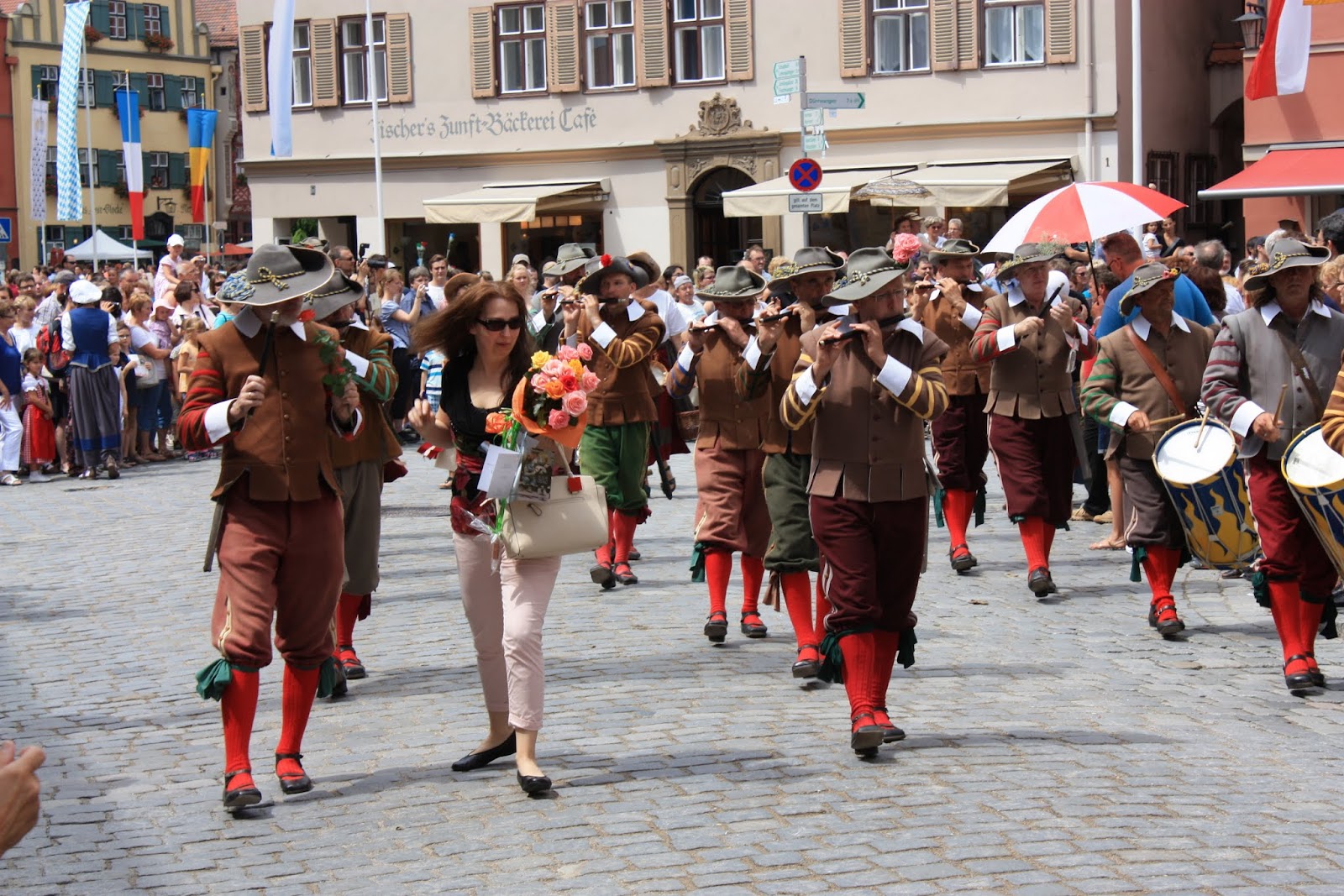
...then the Knabenkapelle (boys' marching band),

... then the Schäferreigens, representing the importance of the wool trade to the city's economy (schaf means sheep); they wear the simple everyday clothes of the sheep farmers, wool handlers and weavers


... then the Tracht (traditional costume) club from Segringen, wearing the traditional costumes of a farming village; these clothes are the Sunday best,

... then the Biedermeier club in their white dresses with hoop skirts; in Germany, the Biedermeier period was between 1815 and 1848 during which the middle-class grew and arts appealed to common people. It was a bit like the 1950s in America. It ended with the failed revolution in the 1840s when people turned away from political involvement and concentrated on their own lives; (I can hear Julie Andrews singing "... girls in white dresses with blue satin sashes,"

... then another group representing the colorful, cone-shaped goody bag that all the participants in the parade receive; the four girls in front are carrying a giant version of the goody bag, called a "Gucke" (it's a traditional name - if you look it up, you won't find the goody bag definition)


... then the smiths' and weavers' guilds' dancing clubs in their tracht; the smiths' guild performs a sword dance and the weavers' guild has their own unique dance. The two guilds competed for precedence in the 17th century.


Lastly, the mayors (all 3 of them; they each ruled for 4 months of the year) and the city council.  


During the parade, the bystanders run out to give the children little bags of candy, and the men get little bottles of alcoholic spirits or flowers.


The parade ends in front of one of the oldest buildings in town, where the viewing stands have been erected. The flag of the city is given to the Swedish forces. The marching band then plays a song written in the 1800s for this occasion. Everyone who knows it sings along. It was also printed in the program we had, so we tried to sing along as well. The opening lines are, "Let songs of joy resound from south, north, east and west" and it goes on to praise innocence, the jewel of youth. It is a song of joy and friendship and ends asking for God's blessing on the country.


It was a wonderful "feel good" day. Maybe because of the emphasis on the kids, maybe because of the flowers being passed around, maybe because of the good food and beer, maybe because of the nice weather and beautiful costumes, maybe because of the setting (I forgot how colorful the buildings in Dinkelsbühl are.)


Sunday, April 12, 2015

Easter fountains and wells

Easter in the hills of Frankonian Switzerland (just north-east of here) is celebrated by decorating the fountains and wells. The sandstone that makes up the mountains doesn't hold water, and wells are sometimes 100 yards deep. In the winter they go dry, but when the winter snow melts in the spring, the wells fill up again, and it is time to celebrate. Traditionally, when the wells and fountains are cleaned out, the rubbish that collected is allowed to dry (for the bonfire that takes place on the night before Easter). While the women cleaned, the girls painted eggs (the symbol of fertility and spring) and decorated the wells with pine boughs and ribbons. During the Romantic period in Germany (the early 1800s), these old traditions became important again, and since then they have become more popular. Today, there are about 300 Easter fountains in Frankonian Switzerland.

In Bieberbach, at the intersection of two of only a handful of streets that make up the town, tourist buses unload people to see the worlds biggest Easter fountain. At least, that's what the Guinness Book of World Records says. More than 11 thousand eggs from chicken, ducks and geese were used.


In Birkenreuth, they still have the old well that they have enclosed in a nice shelter decorated with Easter eggs. Inside, the opening to the well is covered with decorations. Even the rope going into the well has pine boughs twisted around it so that more Easter eggs can be attached.  


The Trachtenverein (Association of traditional costumes) in Muggendorf decorates the fountain in the center of town. They posted some information on making the easter egss. Between one and two hours are needed to make each egg. The steps, as usual, are 1) blow out the egg, 2) paint the background color, 3) paint the decoration,  4) apply a laquer to protect the decoration so the egg can be used in subsequent years, and 5) string the eggs with thread and pearls to separate them. 


  We made it to Muggendorf in time for lunch. We saw the waitress at the Golden Star opening up the beer garden behind the fountain, so we checked in the restaurant for an Easter meal. We were both in the mood for lamb, and two dishes were on the menu, so we each had one. They were both delicious.

After lunch we went to Waischenfeld, where the Heimat- und Verschönerungsverein (Home-town and Beautification Association) decorates the fountain with 2600 Easter eggs. Waischenfeld is on a small river, so the center of town didn't have a fountain. But on the edge of town there is a nice fountain made out of a large piece of the sandstone that makes up the mountains here. 


Our final stop was in Heiligenstadt, where a brass band was playing music as we walked into the town square.