Showing posts with label christmas markets. Show all posts

Friday, January 06, 2017

Traditional Christmas Toys and Decorations in Seiffen

We were in the town of Seiffen for our trip to a remote Christmas market in 2016. Seiffen is in the Erzgebirge (Ore Mountains), so we had a nice train ride through the forests to the town of Grünthal. Grünthal is only about 10 miles from Seiffen, and the hotel in Seiffen provides a shuttle. We had to transfer trains 4 times on the way from Bruck (home) to Grünthal, and we never had more than 10 minutes to make each connection, but we made it without a hitch.

Seiffen is the site of a depleted tin mine. The Erzgebirge is full of old mining towns where various minerals were mined. Over the centuries, as the mines became depleted, the miners turned to making wooden toys.
 The former miners eked out a meager existence. An example of the living conditions is shown in the Spielzeugmuseum (Toy museum). The one main room of the very small house (the only bedroom was upstairs in the attic) has everything the family owns and uses to make a living. The picture shows an oven/heater in the back-right corner, a wood lathe with an oil lamp above it in the front-right corner, bobbins for making lace in the back-left corner, a desk on the left side, and a butter churn in the front-left corner. The dining table is in the middle. I don't know where the meals were cooked, but the oven has the wash hanging in from the ceiling in front of it. In spite of the poverty, there is a beautiful wooden chandelier above the dining table.

Seiffener Kirche
The symbol of the town is the small round church on the hill overlooking the town. The church is recognizable because it is often depicted in the carvings made in Seiffen. The inside is fairly plain except for a nice little organ and some beautiful chandeliers. There a three large ones made from crystal in a nearby village, and there are smaller wooden ones in the windows. When we were there the sun was low enough for the light to strike the crystals, which made colorful spots on the white walls of the church.
wooden chandelier in the church
Fancy wooden chandelier in the museum


The wood chandeliers can get quite fancy. Their shapes are said to be the inspiration for the Christmas pyramids common throughout town.


The town seems to have only one industry, and that is Christmas toy and decoration making. Wood turning is a popular technique used to make the nutcrackers, for example, and the hundreds of figures in the miniature parade of miners shown in the lower photo. This reproduction of the parade was carved in honor of the wedding of two nobles in the 1700s.


Real Erzgebirge-made nutcrackers

  
Miners' parade


I learned about a woodworking technique I hadn't seen before. It is also done on a wood lathe, and an example is in the photo. It is called Reifendrehen, which is literally translated as hoop-turning. On the lathe in the picture is a disk with a ridges on it. I had no idea what those funny bowls were for the first time I saw one. But then I saw one cut diagonally, like the piece in the front of the table in the picture. If you look closely, you can see the profile of a giraffe. After turning the funny ridges (which are the legs and neck of the animal in most cases), the woodworker can cut many slices from the disk and have a start (the profile) of many identical animals. The inexpensive toys are sold as is, but the more expensive versions have the individual legs cut out, the body rounded over, and ears or horns added. The hand painting is very detailed.
Reifendrehen


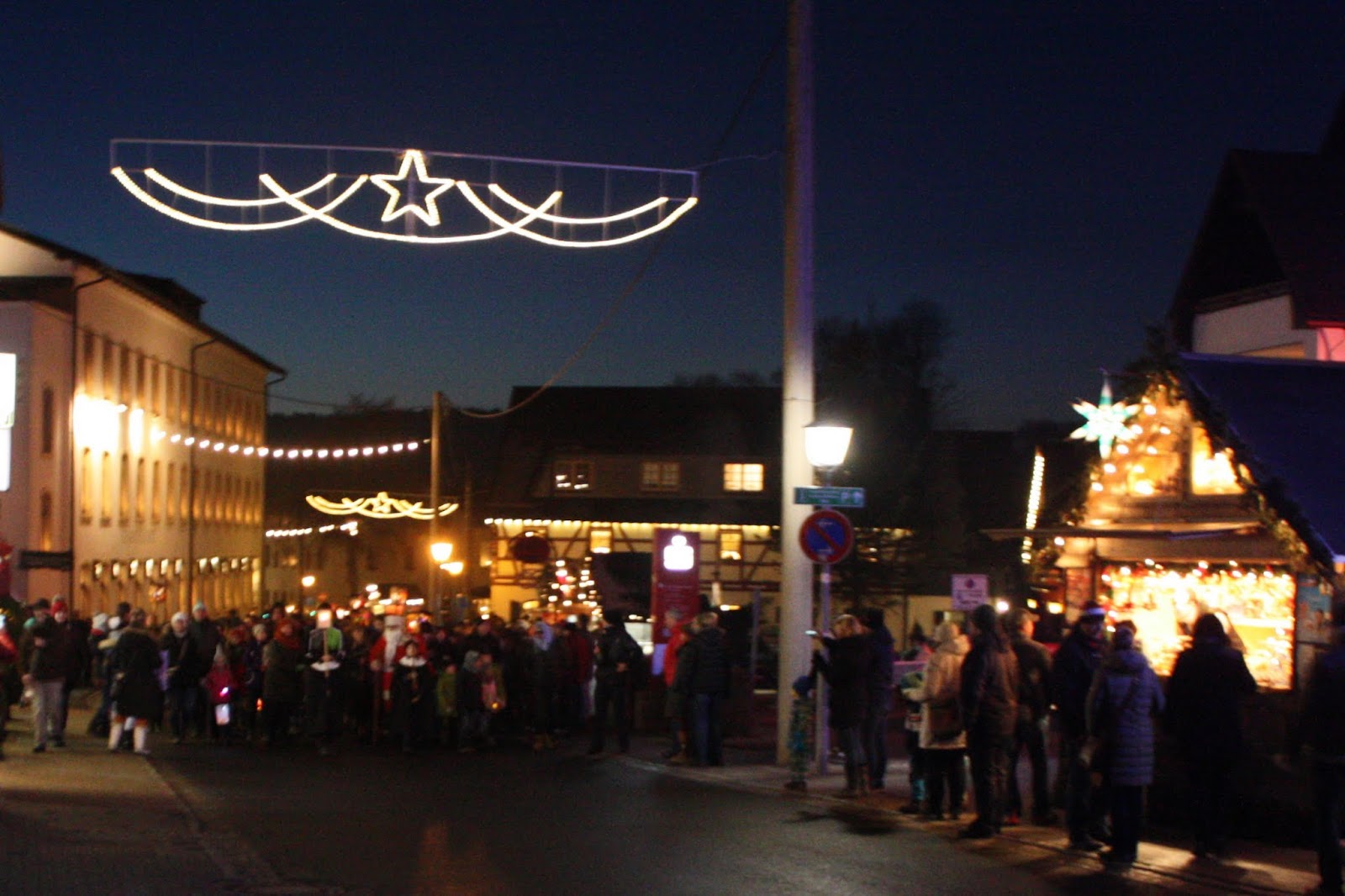
On the evening we were there, the town had a parade of lights. The parade was led by two kids with a lantern on top of a pole. Next came Santa Claus, followed by more kids and families also carrying candles, some in lanterns and some of those on top of poles.

After parading through town, they gathered in in the square in front of city hall, where a brass band played and we all sang Christmas songs. Luckily, they passed out little sheets of paper with the lyrics. Santa gave gifts to children whose parents had presumably provided the gifts and given Santa their children's names.


As the children collected their gifts from Santa, they sang a short song or recited a short poem about the Christmas story or about Santa. We have noticed that children in Germany recite a poem or sing a song anytime they are about to receive a gift in public (and, it turns out, in private Christmas celebrations, too). This includes trick-or-treating at Halloween, receiving gifts from Santa in the town square, or collecting charitable donations when going door-to-door dressed as the Three Kings on January 6th. I can imagine it's meant to impress upon them that you don't get something for nothing.

While we were in Seiffen, we visited one of the workshops where the toys are made. Parts of the workshops were enclosed by glass so we could see the craftsmen and -women turning pieces of toys on lathes, or sanding them, or painting them. We were able to choose, assemble and paint our own toys. We each chose an angel; Kathy's is the blue one on the left and Richard painted the white one on the right. The little white angel with glass wings is a treasure we bought from a shop there:

On the far left is Kathy's angel, on the far right is Richard's. In between is a locally made one with glass wings that we bought. 


Sunday, January 04, 2015

The Christmas Letter: the New Year's Edition

December 30: finally some snow. Richard's collection of ceramic replicas of buildings we know decorates the window sill.


The Good Life
It's 34°F outside, with snow on the trees and everywhere else. The chickadees are hopping around the branches, enjoying what seeds are left. Inside, the borrowed cat sleeps on the sofa, the house is decorated for Christmas and classical music is playing softly on the radio. A warm cup of decaff is steaming next to the computer. The picture above is exactly what Kathy sees as she types this at the dining room table. Richard gets a new little ceramic house from Kathy every Christmas, and the third house from the left is this year's model of the Schlenkerla, a brewery in Bamberg. (Hint: click on any of the pictures in this blog to see a larger version on a separate screen. It's cool!)

We are hosting the downstairs neighbors' cat while they are away. This cat is very attached to her people, so while her personal staff is away, she has adopted us as a substitute. For a couple of days after they leave, while she still thinks they could come back any minute, she stays downstairs in her "lair" and Kathy lets her in and out. After a couple of days, she gets tired of being alone and comes up to spend a few hours a day with us, which then turns into a round-the-clock thing, because she wants company. She also doesn't want to go out in the snow. She has established her favorite sleeping place in approximately the middle of the sofa, which has occasioned some changes in our sitting habits, but she purrs nicely, and it's fun to play with her, so it's a change we can live with for a little while.

The neighbors across the street (the ones with Laika, the cocker spaniel) were away until today, Dec. 30, 2014, so Kathy has been shoveling their front walk, bringing the newspaper in and watering the plants.

As you can tell, we have developed good relationships with the neighbors, so that we take care of each other's pets and plants while we're away. Susanne, Kati and Kathy go walking with Laika (Susanne's cocker spaniel) on most weekdays.

It has been nice to stay in Germany for Christmas. We were enjoying the prospect of having time to relax and visit some Christmas markets after we came back from visiting Richard's family in Iowa for Thanksgiving. For us, it's a time to wind down and spend a couple of peaceful weeks without having to work (mostly). From the afternoon of Christmas Eve until the 26th of December, it's holiday time and stores are closed. Same thing on New Year's Eve and New Year's Day. Then, on January 6, the Epiphany holiday is another chance to enjoy a day without work. We did travel to visit a couple of Christmas markets; more on that later.

What We Did During the Work Week
Those of you who received Bob Leroux's Christmas letter might get the impression that Richard is in a management position. Luckily, he's not - he just has some young engineers working with him that need his "supervision," because, as he affectionately puts it, "the kids know just enough to be dangerous." Richard is now at an age where he is a member of the second oldest age cohort in the company. The people 10 years older than him are looking forward to retirement in the next year. Because of the vagaries of the nuclear industry, there is no one in between, age-wise. A couple years ago, some young people just out of college were hired; these are the people who come to him for advice. Many of the oldest generation come to him for advice as well. He has often been pulled into meetings, to which he wasn't expressly invited, because they need his unique expertise.

During the fall, Richard took an Italian course at the Erlangen adult-ed school. He enjoyed it so much that he even used an online program to practice at home. The woodworking has been on hold until he can make a trip to the saw mill some 20 miles away and get some more wood. He does go down to the shop to putter sometimes and spend time on a wooden clock and some picture frames he's building.

Kathy continues to do freelance translation work from German into English. Since August, she has been busy translating management-standards training documents for a company in Nuremberg who has recently acquired some overseas offices. Most of the training material involves communication and conflict management. Thanks to her exposure to her dad's psychology background and counseling career, a lot of the terms are familiar to her: Transactional Analysis, I'm OK-You're OK and Parent-Adult-Child are some once-familiar themes that she has been re-encountering. This has been solid, full-time work that promises to continue into 2015. A faithful customer from Richard's company also promises to have several pages of technical work for her to edit and translate in the new year.

In addition to walking with the neighbors and the dog on most weekdays, for fun, Kathy takes a water aerobics course once a week at one of the city pools. The weekly yoga course is also a staple. It sure helps to keep up the strength in the arms, legs and core! In spite of all the years of yoga, though, her flexibility is not what she wishes it was. She is looking forward to the Yin yoga seminars her teacher is offering in the new year. Yin yoga addresses the fascia, the tissues surrounding the muscles, by holding certain "restorative" poses for minutes at a time to allow the tissues to stretch. She also took up weaving again, 14 years after her last class at the arts center in Connecticut, weaving a scarf on her tabletop loom. This in turn inspires her to think about the next project(s)...

What We're Reading
On the recommendation of one of Richard's "kids," he has been reading a fantasy series of 6 books in German by an author named Richard Schwartz. Some of the books are written in the style of a murder mystery and some are pure adventure, with magicians. He chuckles often while he reads. Book 6 is on order at the bookstore while he finishes Book 5. He also has a pile of books on his nightstand by authors and poets from the middle ages containing stories from the period and biographies of various personalities.

Kathy is splitting her time between a Christmas present, Engineers of Victory, about the clever people whose inventions and technological advances were indispensable to the Allies' victory in WWII, and certain books by Sam Harris, such as Waking Up and The End of Faith. Harris's premise is that it is not necessary to subscribe to a particular religion in order to have spiritual experiences that give rise to inner peace and compassion for other beings. In fact, religious doctrine can and has gotten in the way of people realizing that everyone can experience consciousness in a self-transcending, productive way. Meditation is the key. For more details, see the books; he has a lot more interesting and controversial, but well-reasoned things to say.  A recent read was a short German book called The Wolf at the Window, a charming Christmas story about a journalist from New York City and a park ranger whose meeting in Wyoming involves an injured wolf and the ranger's purported Uncle "Claus." On Kathy's nightstand, she keeps a copy of the Brothers Grimm fairy tales in German; it was a gift from a German friend. It came in handy in interpreting some figures we saw at the Dresden Christmas Market.

The Christmas Markets: Esslingen and Dresden
We took two weekend trips in addition to the one-day visits to the local Weihnachtsmärkte (Christmas markets). The first trip was to Esslingen with a former colleague, Daniel S. All the elements of a great Christmas market were available: the food and drink, the handcrafts, the music, the decorations and setting, and the entertainment.
Richard at the Glühwein stand
Let's start with the food and drink. Glühwein (mulled wine) was available at  several booths. One in particular sold the local variation made from apple wine and Calvados (apple schnapps). In addition to tasting good, the roasted chestnuts always smell good and feel nice and warm in your hand. As you might expect in Germany, wild game was also available. Kathy bought a Nutella-flavored liquor at one of the booths selling every flavor of liquor you can imagine.
Roasting chestnuts in a big kettle

Booth selling wild game products

A booth selling hand-carved wooden ornaments.
Notice how ornately the roof is decorated.
Hand-blown glass ornaments


Moving on to the hand crafts, there was a wide variety of wooden toys and carvings, hand-blown glass ornaments, hand-made bobbin lace, and hand-made ceramics. The lace actually was made in the same region as that sold at the Dresden markets.


Ceramic models of local buildings, similar to what Kathy buys Richard every year


Medieval Ferris wheel


The entertainment for the kids was in a medieval setting. The Ferris wheel was hand-powered by two knaves. For the older kids, there were archery and axe-throwing booths.


The setting was especially charming. Esslingen is a beautiful little city with a lot of its half-timbered buildings still intact.


Dresden is also a beautiful city, but of a different sort. It is a baroque city on the banks of the River Elbe. It has several Christmas markets with various themes. The main market in Dresden is called the Striezelmarkt, which takes its name from a treat pictured below. The decorations are especially nice here. Near the Frauenkirche, the Church of Our Lady, was a market where local craftsmen sold their wares. At one stand, we bought two hand-turned plates glazed with a holly motif.
The lights of the markets near the Frauenkirche
This market included some delicacies indigenous to Dresden. One of them was the inside-out cinnamon roll (called a Baumstriezel - wrap on a tree, roughly translated), cooked on a greased wooden core (the tree) over an open fire. They gave off a wonderful fragrance as we stopped to watch. Below you see the tray of nuts, cinnamon and sugar that the rolls are smothered in after being coated with melted butter.
Baumstriezel being doused in melted butter, nuts, spices and sugar


The handicrafts reflect the local history, and the Erzgebirge (ore mountains) of the region provided Germany with some of the most traditional of decorations. 
The miners spent the winter months doing woodcarving, while the women made lace. Numerous stands sold both the hand-carved wooden ornaments (Christmas pyramids by the dozens) and handmade lace, all made locally.


The kids had an area of the main market devoted to the Grimms brothers fairy tales.
The princess and the frog, and Snow White and the seven dwarfs


Kathy found a souvenir at a pottery stand selling blue-glazed pottery. She bought two egg cups.

The roofs of all the stands were so ornately decorated, and we can't resist including this picture.
Some pretty cute pigs were pulling Santa's sleigh on top of this sausage maker's stand.


Kathy's favorite Christmas market in Dresden was the one in the courtyard of the former stables of the residential palace of the Saxon princes. It was small, enclosed and cozy, complete with blacksmith, old fashioned bath tubs that could sit 8 people each, a brass quartet who consistently played very good music, which they sometimes accompanied with a drum, and lots of unusual delicacies.

Part of the medieval market in the Dresden residence courtyard

We had liver grilled with meat and bacon on a skewer, hot mead, and some hot mulled wine. A special treat was a booth selling middle eastern coffee and pastries! We could taste the spices in the coffee - it was much better than anything we've attempted at home. We shared a date roll covered in crushed pistachios. Very tasty! We definitely compensated for our surplus energy intake by walking all day to see the various markets around the entire city.


The bath house has two large tubs that seat 8 people each


The bath tubs were set up under the roof of a shed, which presumably served as a changing room. It took all day to heat up the tubs of water. The Baeder, or bath attendant, explained that in the Middle Ages, communal baths were common. It was a social occasion. The bath attendants at the time offered rudimentary medical services, such as tooth-pulling.  Various tools of this trade were on display. Also on display was a bladder full of water with a tube attached to it - the attendant the attendant offered to show Kathy how it worked, but she gracefully declined.


The Epiphany in Germany

The "Star Singers" go from door to door...
...dressed as the 3 Kings


On the 6th of January, Germany celebrates the Feast of the Three Wise Men as a holiday. Every year we get a visit from three kids dressed up as Caspar, Melchior and Balthasar. Balthasar carries the star that led the wise men to Bethlehem, and Caspar has his face darkened because Caspar was a Moor from north Africa. The kids knock on your door, sing a song introducing themselves as the wandering wise men following the star, and ask for a donation to a charity that helps children in need. This year, the donations supported children in the Philippines. In return, you get a blessing, indicated by the markings in chalk at the top of your door. The inscription reads "20* C+M+B *15" indicating the year, 2015, and the initials not of Caspar, Melchior and Balthasar, as we assumed, but Christus Mansionem Benedicat - Christ bless this house.


Final Words
We continue to enjoy the Christmas traditions here in the "Old Country." That these traditions continue to be maintained is part of what we love about living here. There is a sense of continuity and that things are the way they should be that the Germans try to preserve despite all their country's ups and downs. It gives us a comforting sense of stability.

We also appreciate and continue to practice the American customs that we grew up with, such as putting up the Christmas tree right after Thanksgiving and opening presents on Christmas Day (the Germans put the tree up and open presents on Christmas Eve). We also cannot do without colored lights and ornaments of all colors on our tree! When our German friends get to reminiscing about their families' Christmas customs, we realize that we Americans, too, have our own unique customs. We just hadn't recognized that we do have a unique culture until we had another one to compare it with.

We wish you all a happy, healthy and successful New Year!

An American Christmas tree in Germany


Sunday, December 16, 2007

And so this is Christmas...

From the John Lennon song subtitled "War is Over." The next line is "and what have you done?" OK, I confess, Not Much. But - this year I managed to bake cookies for the neighbors and get gifts for all the nieces and nephews (11 + 1 godson and 2 friends' kids). I know, Lennon was talking about world hunger and misery, and so on. I'm still working on that one...

In the meantime, I've done lots of reading and introspection, the kind that's unavoidable when one has no employment and the library is a free place to spend time. The Christmas spirit comes through in fits and starts. The first Sunday of Advent, when the Christmas markets open here in the Old Country was cause for excitement. We've been to markets in Bamberg, charming and sprawling but manageable; Erlangen, compact; Nürnberg - a zoo, I don't know why we do that to ourselves every year; Schloss Tambach near Coburg in the castle of the Countess of Ortenberg with a flaming torch procession through the grounds - more on that later; and Forchheim on the square in front of the medieval town hall, whose windows have been turned into an Advent calendar. Each one has its own charm. All are full of booths selling traditional Christmas treats: hot spiced wine, hot spiced beer (we've not tried it yet) , steamed doughy buns full of rich plum filling coated with poppy seeds and doused in vanilla sauce, hot roasted chestnuts, roasted sugar coated nuts, and of course, bratwurst in a roll with mustard. Christmas ornaments are sold by the boxful and by the handcrafted piece.


The German Christmas tree is a sedate affair. The ones I've seen usually stick to one color scheme, with traditional straw ornaments complementing the red glass balls, and maybe some ribbons, with white candle-like lights replacing the traditional real candles. House decorations are also low key. White lights on the evergreens in the yard is the extent of the external display. In the windows, people display seven-light electric candelabras or wood carved, backlit nativity scenes. 

It takes the Americans to really tart things up! To wit: last night, our old friends from Heroldsbach, Peter and Ulla, drove us to see what they call the "Chevy Chase" house, a reference, of course, to that American classic "National Lampoon's Christmas Vacation." They said that this house informed their picture of an American house decorated for Christmas. It so happens that this house is owned by an American and his German wife. For years, he's asked visiting relatives to bring American light strings and good old-fashioned American lawn ornaments with them on their visits. The result is, for Richard and me, a blast from the past. Multicolored, blinking light strings, those old glass bulbs that used to overheat and burn your hands while you put the ornaments on the tree, Santa in his sled and reindeer that bow their heads and move their feet, a huge, white aluminum Christmas tree of 60's or 70's vintage, plastic lighted candy canes with the red color wearing off, a giant snowman kept upright by a blower, a snow globe similarly run. The yard was full of carefully staged and displayed classic Christmas pieces. Colored icicle light strings ran from the roof peak to the fence. A very bright Christmas angel adorned the peak of the roof. Ulla says you can't buy this stuff in Germany - she might have been teasing by implying that it should be illegal to sell such garish, gaudy things. Peter took all kinds of photographs, until his digital camera gave in to the sub-freezing temperatures.


In traditional American fashion, this display was financed from the husband's small pension and his wife's unemployment check. They had both been laid off from the large Manufacturing Concern AEG in Nuremberg when it closed last year. The family offered hot spiced wine and hot punch for the kids; there were mini candy canes, Brach's hard peppermints and toffees with the green Christmas tree in the middle, and seasonally wrapped mini Hershey bars free for the taking. All donations went to an animal rescue shelter.

It does get cold here, but...
Germans don't wear hats and gloves - too stylish and smart. I, on the other hand, being a sober, common-sense North Country girl, do not hesitate to wear what keeps me warm, damn fashion.
"When it's 10 below zero and the wind is whipping across the tundra, there is no such thing as stylish and smart, and everybody's nose runs. " http://www.salon.com/opinion/feature/2006/12/13/keillor/

Christmas is best enjoyed with kids
With these old friends we went to the Christmas market in Forchheim, not for the food, but this time for the Krippenweg - the path connecting the nativity scenes (Krippe) in old churches and buildings around medieval Forchheim. A display of these scenes is part of several Advent displays in Germany; Bamberg has a whole museum for them. The ones we saw were that much more interesting because 10-year-old Pia was with us. She inserted the coins that made these extensive 100+ year old landscapes light up and begin to move! Around the central stable or barn building, peasants sawed wood, churned butter, tended geese. Swans swam on a pond while a water wheel spun, propelled by the outflow of the pond. Pia was curious about what the old-fashioned characters were doing. Blacksmiths hammered, an old woman pumped water from a well, and from the far side, the three kings approached from their fancy tents, accompanied by white-turbaned bearers. One krippe could display six different scenes according to the progression of the Advent season. During our visit, the angel's annunciation to Mary was being depicted. Pia asked her mother, Who's the person in the building with Mary? The krippe in the Old chapel associated with the former emperor's palace depicted the half-timbered town hall and buildings of Forchheim's town square, with Joseph leading the donkey that carried Mary. Mary, unfortunately, was face down in the dirt, having fallen off the donkey. None of the peasants depicted in the scene was rushing to her aid. Presumably divine intervention was required to open the display and put Mary back in her place.

As for the torchlight procession at Schloss Tambach: the burning four-foot long wax torches were in the careful custody of -- the kids! None of them over ten years old! We were careful not to turn our backs on the little torch wavers, and incredulously told Ulla and Peter that this would never be allowed in the US! We followed the circuit through the pitch-dark grounds of the castle - they have a sort of wild animal refuge full of deer and other four-legged, hoofed characters- all the while marveling at the relative restraint of both kids and parents. We found our way, unscorched, back to the castle and rewarded ourselves with a mug of hot spiced wine and more shopping at the tea, chocolate and jewelry vendor tables in the cellar rooms and the stables.

Yuletide lessons
Seeking traditional Yuletide carols being sung by a choir, we were drawn to the poster outside the Huguenot Reformed Church in the center of town advertising "A Festival of Lessons and Carols for the Advent Season and Christmas" - in just those English words. We showed up at the appropriate time and were handed a thick booklet of hymns, and an order of service. I asked about the ticket prices, and the greeter at the door said there was no entry fee. We had unknowingly stumbled into an annual English service at this church. Everything was in English! Including all the readings from the Bible (so that's what "lessons" are - don't know how I missed that detail in my Catholic education! ) All the carols were in English, too! We are still mystified. (Maybe it's a Protestant thing? See the historic note below) The pastor (Rev.) and her husband (Prof.) led the service in perfect English, with maybe a hint of German grammar creeping in. The readers read in good solid English, with a hint of German pronunciation thrown in. Some around us were singing "Hark ze Herald Angels sing." The organist often got a little ahead of herself and the order of service, so it was hard to sing with her, but the choir sounded good after a shaky start. We enjoyed the chance to sing carols with other people, but next year we will get advanced tickets for the boys' choir.

So finally, the Christmas spirit took hold, and if 24 hours of flight and airport time doesn't kill it, we look forward to celebrating with family in the States in two days.

Merry Christmas!

Historic note: around 1686, a flood of French Protestant refugees were invited to settle in Erlangen by the local Lutheran count. These Calvinists built the Huguenot Reformed Church for themselves. It stands on one of the two main squares in the center of Erlangen. Given that the church was built by the French Protestants, we were surprised that the service wasn't in French. At this point, the evidence of these French Protestants, who settled as craftsmen and farmers, exists primarily in family names, some of which label a café offering fancy cakes and pastry, a garden center and a family farm. As far as I know there are no religious services in French in the local Protestant churches.