Showing posts with label Riemenschneider. Show all posts

Monday, November 01, 2021

Riemenschneider's Last Supper and Rothenburg

 It was a beautiful fall day on Halloween, so we made a day trip to Rothenburg ob der Tauber.

Galgentor (Gallows Gate)

We took the train and walked from the station to one of the city gates. The medieval town is surrounded by a city wall that you can climb and walk around the city on.

Walking the city wall


The city's history goes back to the Hohenstaufen dynasty of the Holy Roman Empire, which included Konrad III, who ruled from 1138 until his death in Bamberg in 1152. Holy Roman Emperors did not collectively have a permanent residence; instead each had a home base. Konrad did not have a home base large enough for someone of his position, so he decided to build one on a hill overlooking the Tauber river.

Pilgrimage route
Konrad built his castle in 1142, and of course a village grew up around it. Konrad built his castle at the crossing of two important pan-European routes. Of the three most important pilgrimage destinations in Christendom (Jerusalem, Rome, and Santiago de Compostela) Rothenburg was along a north-south route to Rome, and also along one of the east-west routes called St. James' Way to Santiago de Compostela, where the tomb of St. James is located. The most important church in Rothenburg is St. Jakobskirche (St. James Church), built next to the north-south route. When the church was enlarged with an addition to its west end, the addition had to bridge over the pilgrimage route, because you know you don't change pilgrimage routes! 

Coat of Arms


Rothenburg obtained official market rights in 1172, which was a big deal because of the money that could be made. (Have you read Ken Follett's novel Pillars of the Earth?) Rothenburg gained in importance, and in 1274 the Holy Roman Emperor, Rudolf I, made Rothenburg a Free Imperial City, meaning that it did not belong to one of the Princes, Dukes, Counts or other rulers that made up the empire. Rather, it belonged to the emperor himself. As such, the city also obtained a Reichskammergericht, (Imperial Chamber of Justice), which is represented by the small building between the two towers in the city's coat of arms. By 1400, Rothenburg was second only to Cologne in size. The first fortress walls surrounding the city enclosed a relatively small area. Part of the original wall was made of a Spital, which was a combination hospital, old-folks home, and hotel for pilgrims. These people were associated with disease, and that is the reason for not letting them stay long inside the city. Monastic orders also put up pilgrims in the monasteries overnight, even though they were inside the city walls, but religious buildings were officially part of the Roman Church and did not fall under the jurisdiction of the city.  

Röderbogen (Markusturm in background)
One of the remaining towers from the old inner wall is the Markusturm (Markus tower), shown with its city gate (Röderbogen) in the photo. Another is the Weißer Turm (White tower). You can see some of the many business signs extending from the buildings and hanging over the street. They are very decorative, and original to the medieval situation when people were illiterate. So the signs had to show what business was located in the shops. A tour guide told us that the city fathers knew very well how important the signs were, and so imposed an "air tax" on the signs hanging over the street. The business people were clever, and they put the signs on hinges in order to bring them up against the buildings.
Weißer Turm


High Altar in the chancel of the church


Inside the first town wall is the Jakobskirche, mentioned earlier. The current church was started by the Teutonic Order of Knights in 1298. Only the chancel (the part occupied by the priest and monks) was built in the first of three stages. It was butted up against an older Romanesque church, and when the chancel was complete in 1322, the Romanesque church was torn down. 

The chancel contains a stone altar piece with an early depiction of the trinity as the Father, the Son, and a dove as the Holy Spirit all together. The beautiful colors must be older than 1544, because after the Reformation came to Rothenburg at the end of the Peasants' War, the church became protestant, and colored statues did not adhere to Martin Luther's ideas. One reference I read said that Friederich Herlin, the same person who made the altar, also painted the older stone altar. 

Early depiction of the trinity

Behind the high altar are scenes painted on the wood. There are several scenes of St. James, and in particular of the transport of his dead body to the church in Santiago de Compostela.  The painter of the scenes had never been there, so he used Rothenburg instead. The result is the first depiction of Rothenburg's market square and city hall and the first aerial view of a city to be achieved in southern Germany.

Rothenburg's market square above


Nave of St.Jakobskirche


The second part of the church was then constructed from 1372 until 1436: the part of the nave extending almost to the organ. Construction had to stop there, because the pilgrimage route was just outside. The third part of the church was constructed from 1453 until 1471, and it is the part that contains the organ and that bridges the pilgrimage route. It is also the part that contains Tilman Riemenschneider's Holy Blood Altar.


Riemenschneider carved the scenes in the altar from 1501 until 1504, and the main scene depicts the last supper. This is in keeping with the reliquary, which contains a piece of cloth with three drops of consecrated wine (hence, the blood of Christ). The reliquary is a piece of rock crystal mounted at the center of the crucifix.

The depiction of the last supper is unusual, because it depicts Judas in the center rather than Jesus, who is slightly to the left and higher. Judas is depicted with a back of money in his left hand. Notice that next to the bag is the face of the apostle John, who has collapsed onto Jesus's lap in distress.


Holy blood reliquary


Last supper by Riemenschneider


We had a wonderful day in Rothenburg, and we sat outdoors for a meal of venison cubes in a dark wine gravy with spaetzle and batter-fried carp, two traditional Frankonian dishes. The restaurant's outdoor seating was on the site of the former cemetery of St. Jakobskirche, and the former chapel building is still next door.

former cemetery chapel


The reason Rothenburg is so well preserved is that its significance waned after the destruction suffered from the Thirty Years' War (1618 to 1648) that left 2/3 of its inhabitants dead. The city never recovered from this era. The medieval architecture remained frozen in time. That anything at all survived  the war is, according to folklore, due to the mayor Georg Nusch (Nu-sh). In 1631, the troops of Catholic General Tilly with his army of 40,000 troops laid siege to the protestant town. The town was therefore threatened with starvation, and so the town sent out women and children to plead for the town, but the General was not deterred. Finally, the mayor made a wager with the general. The mayor claimed to be able to drink over 3 liters of Franconian wine in one gulp, known as the Meistertrunk (Master Draught). A recreation can be seen every day in the glockenspiel next to the city hall at noon, and also every year the Meistertrunk is reenacted during the town festival.

What survived until the 1940s was seen even by the Germans as the ideal German town and for the Nazis it came to represent the ideal German home town. So it was occupied by German forces when the Allies bombed it on March 31, 1945. Because the U.S. Assistant secretary of war, John McCloy, was told of the town's beauty by his mother, he ordered that no artillery be used when the Americans took the town. Luckily, the American forces were able to convince the Germans to surrender without a fight (contrary to Hitler's orders), and the town was spared further damage. 

However, 40% of the town's buildings had already been damaged, mostly on the city's east side. To retain its charm, the damaged buildings were rebuilt in a style as close to the original medieval style as possible. McCloy was later made an honorary citizen.

Besides the charming lanes and streets and towers and houses in the old town, one of the most famous attractions is the Christmas museum associated with the Wohlfahrt family. Their famous store is called Käthe Wohlfahrt; open year round, it offers Christmas ornaments made in Germany and it is so crowded with tourists that in the store itself, visitors are guided through the store on one-way only paths. But you don't have to go to Rothenburg to see a Käthe Wohlfahrt Christmas store. There's one in Nuremberg, a 20 minute train ride away from us. 

Another attraction is the "Criminal Museum", which includes shudder-inducing authentic examples of common medieval torture devices, all instruments of what passed for justice in those years. Kathy remembers how disturbing her first visit to this museum was, and does not want to go back there. However, the museum has since added exhibits about how justice was perceived in the middle ages up through today, and there is information about the witch persecutions of the 1600s and 1700s. 

Today, Rothenburg is indeed charming. It is well worth visiting in the off-season, when busloads of tourists from all over the world no longer throng the streets.

Sunday, November 03, 2019

Creglingen - medieval charm and rustic food, November 2019

We had a long weekend due to the All Saints Day holiday on Friday, so on Saturday we borrowed a friend's car and took a ride in the country.  The weather was cool and started out cloudy and a bit wet, and the trees on the hillsides were dressed in fall colors of mostly yellow and dull orange, with some green left over. As we drove further west, the sun came out. We drove about an hour and a half west past Bad Windsheim and Rothenburg ob der Tauber until we got to Creglingen.
https://goo.gl/maps/nGoo7oiv6DaKVPBYA
It's a small place on the Romantic Road that runs south from Wuerzburg. Our goal was to spend the day in a quiet little town with some cultural attraction.

We found it just outside of town in a little church built in 1389 called Herrgottskirche (the church of our lord God). Inside is one of the most important works by the late Gothic sculptor Tillman Riemenschneider.

Sometime between 1490 and 1510, Riemenschneider built a wooden altarpiece depicting the assumption of Mary into heaven. It was the first time that the assumption was the main subject in an altarpiece; previously the assumption had been depicted only in illustrations of books. The shrine sits on a stone altar, which sits on the spot where a farmer is said to have found an intact communion host while plowing his field. (An open arch into the stone base of the altar allows a view of the dirt where the host was found.)


The center of the shrine shows Mary being lifted by five angels into heaven. She is surrounded by the twelve apostles. The faces are very expressive, especially St. James the Elder, shown in the front row on the right.


Around the center, the altarpiece shows the seven joys of Mary:

  • The Visitation, in the upper left panel
  • The Annunciation, in the lower left panel
  • The Nativity of Jesus, in the upper right panel
  • The Presentation at the temple, in the lower right panel
  • The Adoration of the Magi, in the lower left predella 
  • The finding in the temple, in the lower right predella
  • The Coronation of the Virgin in superstructure

All are masterpieces. Richard especially likes the annunciation, with the archangel Gabriel floating in from the left, and Mary twisting her head away from her book to greet him. And what is that vase doing on the floor?
The superstructure has a depiction of Mary being crowned by two angels, with God the Father and Jesus at her sides.

Along the bottom in the right niche of the predella is the scene of the twelve-year-old Jesus teaching in the temple. The scribe on the right is said to be a self-portrait of Riemenschneider.

There are more treasures in this little church. Richard especially likes the fresco of St. Christopher on the wall in the chancel.

The outside of the Gothic church had some intriguing features. The stone face below is definitely from an earlier era, judging by its primitive style. It could belong to the Romanesque style from the 9th century, when the pagan days were in the not-so-distant past.
In addition to the carved altar piece, the church also had 3 brightly painted altars from the late middle ages (1490-1510).

By the time we found the church (which was not yet open), we had been on the road for more than an hour and a half, our breakfast was about 5 hours in the past, and Kathy was very hungry. Across the road were a thimble museum and a small, homey restaurant that advertised that they welcomed bikers, complete with a small motorcycle mounted on top of the wall around the terrace. When we walked in, a tall, tattooed man in a black T-shirt with brush-cut hair, a couple of earrings and a bluetooth headset in his ear, was the only occupant of the small dining room, but we smelled cigarette smoke. Turns out that behind the door to the back room, designated as a smoking room, the place was full of regulars. He took our order, offering a choice of potato soup with sausage, or a goulash soup, which means a type of spicy beef stew (no macaroni), accompanied by sour dough bread. Two shallow, blue enamel bowls with matching enamel spoons arrived on the table, and the stew came out in a matching covered, enamel pot with a cover and a ladle. Besides the homey, attractive presentation, it hit the spot! This café probably gets some tourist business because of the church, because the woman who brought out the food spoke a bit of English. There were also funny signs in English posted around the walls, along with Bavarian and Wuerttemberg memorabilia.
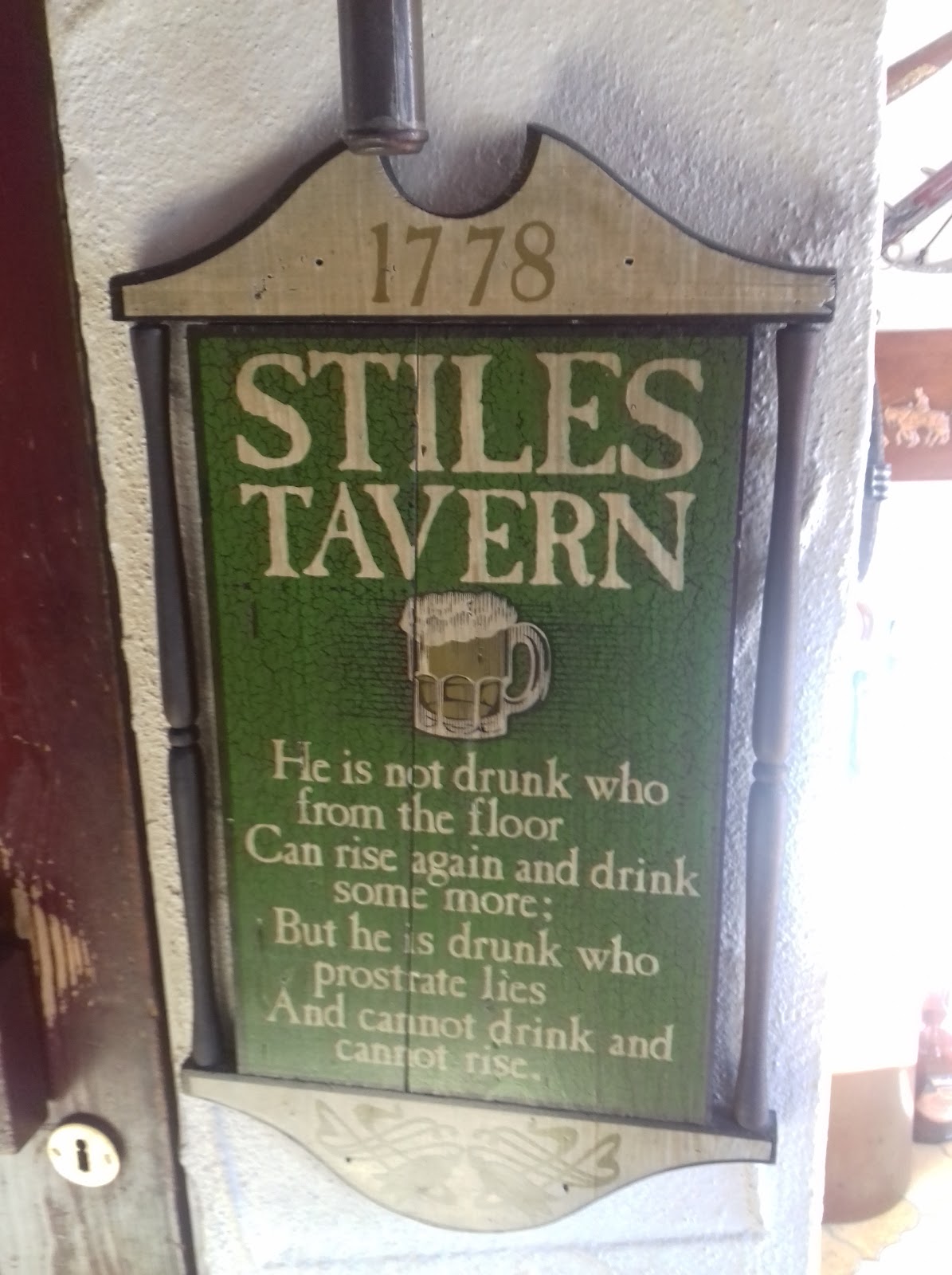
This witty sign was posted inside, next to the door. "He is not drunk who from the floor/ Can rise again and drink some more; / But he is drunk who prostrate lies / And cannot drink and cannot rise"


On the way to Creglingen, we went through the small town of Detwang, https://goo.gl/maps/rYNgWubKcA5dg6ee8, which also claimed to have a Riemenschneider altar. An old water wheel was prominent at the road side. We were following the course of the Tauber river, and countless signs indicated old mills, including oil mills and grain mills.


 Detwang's Riemenschneider altar was in a small church, seen below, but visiting hours were only on Sunday after the 10:00 service so we didn't get to see it. The old church itself was surrounded by a wall with a gate tower. Relatively recent gravestones surrounded the church. Remember that grave plots in Germany are reused throughout the centuries, with the bones of past occupants removed and stored somewhere else in ossuaries on sacred ground, while the recently deceased are buried in the plots leased by new families, or even the same family for centuries or decades.


In Creglingen, along the river, this figure was holding court. Kathy is sure that the artist intended her to be a cheerful representation of a harvest goddess. Her breasts were equipped with pipes that would have sprayed water into the basin surrounding her.